Have you ever mentioned a book in your WIP?
What about ruined the ending?
In PRODIGAL MAGGIE, Maggie ruins the ending of an old (published in the 1930's) classic for another character. It's a book that's on pretty much every summer reading list in America.
Now, I'm not of the school that says, "Hey, it's been out xx number of years, it's free game." I've been known to hush people (politely) at HP film premieres so the surprise remains intact for those who only watch the movies.
Maggie ruining the book is not integral to the plot, and I could use another device to accomplish the purpose the scene currently serves.
None of my betas (except Bear) mentioned an issue with this either way (correct me if I'm wrong here, betas), so I'm wondering...
What is your opinion? Is this something I should leave for now, and if my theoretical future agent and/or editor takes umbrage, change it then? Are there legal issues with mentioning (and ruining) the end of a book in another book?
Also, have you entered my 200 followers contest yet? It's fun and easy to enter!

Showing posts with label writing. Show all posts
Showing posts with label writing. Show all posts
April 05, 2011

February 24, 2011
The tortoise's goal

For a few weeks now, I've been writing approximately 250 words every day, Monday - Friday. Right now, I have 4,927 words. That may not seem like a whole lot to a writer, but think back to when you were in school and a 1,200 word essay felt forever long.
Five-thousand words, while not a book, is still a lot of words. It's a 10th of a short YA novel. And a 10th plus a 10th plus a 10th... you get my picture... equals a novel.
I took a few months off after sending MAGGIE out to betas, and while it was fun and creatively necessary to take a break, I found myself itching to write again about a month ago. I wasn't ready to begin work on MAGGIE since I didn't have all my critiques back, so I started something new that had been swilling around in my head, an apocalyptic YA survival story.
I'm averaging 250 words in 15-30 minutes, depending on how distracted I am and how easily what I'm writing flows that day. If I could keep that pace up over many pages, I'd have a first draft in no time. But realistically, considering my temperament, environment, and attention span, it would be impossible (and undesirable) to align my expectations to that pace.
I'm going to keep writing 250 words a day as I polish PRODIGAL MAGGIE. Once I start querying, I'll up my daily goal to 1,000 words. For a 60k book, it would take me about 12 weeks to finish a first draft. That's significantly less time than it took me to pound out MAGGIE's first draft.
Maybe I'll find 1,000 words a day to be a breeze. Maybe some days I'll get on a roll and write double my goal. Maybe I'll realize 4 pages is just not realistic. I'll adjust as necessary.
Regardless, I've found that a goal, a systematic goal, no matter how large or small, provides me the best chance of finishing.
Do you have a concrete writing goal?
November 04, 2010
On pet peeves and mistakes
I am a good writer.
I know this to be true, and can say so without feeling like a jackwagon (my new favorite insult, thanks to that GEICO commercial), because nearly every teacher from elementary school up through college, an editor and an agent, and a regional newspaper editor have told me so. To me, this is the same as saying I'm white or I have green eyes. It's a fact.
Now, whether I am a good novel writer (in which storytelling is just as or even more important than the writing), or whether I'm a good writer compared to JK Rowling or Stephen King or Neil Gaiman, I don't know.
But I do know the difference between you're and your, their, there, and they're, its and it's, and all those other writer pet peeves (which are not necessarily my pet peeves).
I know, and yet I still catch myself messing up. My biggie is using it's instead of its. It's (ha) like my fingers just love typing that apostrophe.
I've forgotten how to spell 'all' (I was trying to spell it out like it sounded... a-w-l in my slightly-Southern-tinged pronunciation).
My comma usage is far from standard.
And somehow, even though the writing community is one of the most welcoming and least catty I've been a part of, I'm surprised by the amount of Ugh! I can't believe they don't know that [insert writing mistake - or maybe not - here] I see.
And if you're guilty of this, don't feel like I'm aiming this at you. I'm not writing this to call out or tear anyone down. I'm sure I've been guilty of it at some point, too.
People have a right to their pet peeves. I have them, trust me. But it's important to remember that just because someone spells definitely "defiantly" or "definately" or says "for all intensive purposes" instead of for all intents and purposes or uses impact as a verb doesn't meantheir there they're a bad writer.
(The above is not a poorly-concealed list of my pet peeves, by the way, but several more biggies I've noticed batted around the blogosphere.)
Just because someone uses commas wrong doesn't mean they're a bad writer.
Just because someone does something that makes you crazy when you see it in print doesn't mean they're a bad writer.
Just because someone uses just way too many times in a blog post doesn't make them a bad writer.
Just something I've been thinking about.
;)
I know this to be true, and can say so without feeling like a jackwagon (my new favorite insult, thanks to that GEICO commercial), because nearly every teacher from elementary school up through college, an editor and an agent, and a regional newspaper editor have told me so. To me, this is the same as saying I'm white or I have green eyes. It's a fact.
Now, whether I am a good novel writer (in which storytelling is just as or even more important than the writing), or whether I'm a good writer compared to JK Rowling or Stephen King or Neil Gaiman, I don't know.
But I do know the difference between you're and your, their, there, and they're, its and it's, and all those other writer pet peeves (which are not necessarily my pet peeves).
I know, and yet I still catch myself messing up. My biggie is using it's instead of its. It's (ha) like my fingers just love typing that apostrophe.
I've forgotten how to spell 'all' (I was trying to spell it out like it sounded... a-w-l in my slightly-Southern-tinged pronunciation).
My comma usage is far from standard.
And somehow, even though the writing community is one of the most welcoming and least catty I've been a part of, I'm surprised by the amount of Ugh! I can't believe they don't know that [insert writing mistake - or maybe not - here] I see.
And if you're guilty of this, don't feel like I'm aiming this at you. I'm not writing this to call out or tear anyone down. I'm sure I've been guilty of it at some point, too.
People have a right to their pet peeves. I have them, trust me. But it's important to remember that just because someone spells definitely "defiantly" or "definately" or says "for all intensive purposes" instead of for all intents and purposes or uses impact as a verb doesn't mean
(The above is not a poorly-concealed list of my pet peeves, by the way, but several more biggies I've noticed batted around the blogosphere.)
Just because someone uses commas wrong doesn't mean they're a bad writer.
Just because someone does something that makes you crazy when you see it in print doesn't mean they're a bad writer.
Just because someone uses just way too many times in a blog post doesn't make them a bad writer.
Just something I've been thinking about.
;)
October 19, 2010
Impossible possibilities
I've been writing full-time for 3 years now.
It took me a year to find my niche, to start a book that I knew was for real, a year full of stops and starts and beginnings of the wrong novels and frustration and research and... blah.
It's taken me 2 more years to write PRODIGAL MAGGIE, my 78,000 word YA contemporary fantasy.
(And tell me why I feel the need to apologize for being a slower writer than some, though I know I have nothing to actually apologize for? That's another post, though...)
I will never forget the feeling of writing 30 pages of something I knew could succeed, but seemed so darn impossible to finish. Heck, 50 pages seemed unreachable. I wouldn't have believed I wrote 30 pages if they weren't right there in front of me.
But then I hit 50.
100.
And then 150.
All the way up to the nearly-complete 308 pages it stands at today.
For anyone just beginning, or for anyone who can't remember how on earth they wrote that last book, or achieved 10 or 50 or 100 pages, remember:
It always seems impossible.
As Kiersten White, New York Times Bestselling author of PARANORMALCY, wrote on her blog today:
[Books are] completely impossible, except for when they aren't.
October 07, 2010
When you think of something already thought of
I recently finished CLOCKWORK ANGEL by Cassandra Clare.
In Clare's MORTAL INSTRUMENTS and INFERNAL DEVICES series, a treaty called the Accords is often mentioned. CLOCKWORK being the first of Clare's work that I had read, I was disappointed to learn of The Accords.
You see, my novel also features a peace treaty of sorts called the Accords.
Obviously, I didn't rip Ms. Clare off (I was inspired by the Camp David Accords, actually), but I wonder if her books being so popular means I need to rename my treaty? I'd prefer not to, but at the same time, I don't want readers unwittingly assuming I stole from one of their favorite authors.
I thought I'd throw this out there, since this is the second accidental similarity I have come across. You see, one of my betas pointed out that my novel and an already-published YA novel share a main character's nickname and last name. It's not like the character is Bella Swan, mind you, (I actually hadn't heard of the book until beta mentioned it) but still...
How do you handle accidental similarities between your WIP and an already-published novel? Do you change it? Bring it up with your agent (if you have one)? Leave it up to your (hopefully eventual) publisher to decide?
October 01, 2010
SPEAK Loudly
There are a lot of things in life I don't understand:
Why it rains right after you wash your car;
Why the grass isn't always greener on the other side;
Why a single man in possession of a good fortune must be in want of a wife;
How a single F-word could offend someone so badly that they put down a book or walk out of a movie (but that's a whole other post);
How a person or group could seek to ban (or even burn) a book.
I wasn't going to post about the SPEAK controversy because I didn't feel like I had anything new to contribute to the discussion, but I just couldn't go without saying my piece.
It's been covered thoroughly enough throughout the blogosphere, but in case you aren't familiar, it goes something like this:
Dr. Wesley Scroggins wrote an opinion piece for the Springfield News-Leader on September 18 criticizing aspects of the Republic school district's curriculum, including the age-appropriateness of sex education (again, whole 'nother post) and high school reading requirements.
Specifically, the inclusion on said list of Laurie Halse Anderson's SPEAK, Kurt Vonnegut's SLAUGHTERHOUSE 5, and Sarah Ockler's TWENTY BOY SUMMER.
Full disclosure, I've never read any of those books. And I'll be honest: I've never been interested in reading them until now.
But regardless of whether I want to read them, it is of paramount importance that I have the right to do so should I so choose.
I'll be the first to say Dr. Scroggins is well within his rights to write that article. My brother fights every day so people like you and me and Dr. Scroggins may continue to enjoy the freedoms of speech and press. Dr. Scroggins has as much right to say and feel as he does as I do to rebut him.
But what one can do and what one should do are vastly different. As different as, say, what is permissible and what is moral. It doesn't take a PhD to know that presenting a book — a written document, a medium from which our fiercely-held freedoms flow — as cavalierly as Dr. Scroggins did in his article, in a manner meant to influence and rally, is wrong.
Effective, sure. But also wrong.
I feel most strongly about SPEAK, because it was the most unfairly framed, but also because its access being limited has the potential to do the most harm. You see, SPEAK is about overcoming rape, about transitioning from a victim to a survivor, and it has helped countless women (and maybe some men, too) overcome a seemingly insurmountable obstacle. It has helped people. It has helped people heal.
But Dr. Scroggins dismisses the book:
In high school English classes, children are required to read and view material that should be classified as soft pornography.One such book is called "Speak." They also watch the movie. This is a book about a very dysfunctional family. Schoolteachers are losers, adults are losers and the cheerleading squad scores more than the football team. They have sex on Saturday night and then are goddesses at church on Sunday morning. The cheer squad also gets their group-rate abortions at prom time. As the main character in the book is alone with a boy who is touching her female parts, she makes the statement that this is what high school is supposed to feel like. The boy then rapes her on the next page. Actually, the book and movie both contain two rape scenes.I know everyone else has already said it, but pardon moi, how is rape soft pornography?
I'd be genuinely interested in knowing whether that phrasing is poor word choice on Dr. Scroggins' part, or if he really believes it.
I don't have to read SPEAK to know it's not a romance boasting stolen glances and soft caresses. I don't have to read SPEAK to spot the hyperbole, fallacy, and euphemism in Dr. Scroggins' description of it... all persuasive devices, meant to stir concerned individuals into action without knowing the truth.
And sure, the burden of truth isn't necessarily Dr. Scroggins' responsibility. He simply conveyed his opinion and tried to persuade others to feel the same. It's up to the individual to read the book before taking potentially harmful action.
But we all know the mob mentality exists. And at least mentioning the reason the book was introduced into the curriculum in the first place, providing a sense of context, is the difference between what one can do and what one should do.
By using the word pornography, the connotation it carries (even padded by the modifier 'soft'), implies consensuality, thereby devaluing the subject matter. As does the euphemism 'female parts' — is the word for a female's sex/reproductive organ so dirty in and of itself that Dr. Scroggins cannot even print it? And why say 'touching her female parts?' Why not 'groping her,' 'touching her,' 'fondling her'?
Could it be to downplay the fact that the book is a meaningful part of the curriculum, that despite Dr. Scroggins' objection to SPEAK's content, there was a reason beyond titillation in choosing it?
Without meaning to (because surely, as easy as it would be to paint Dr. Scroggins as a villain, he is likely just a man acting on what he believes is best), Dr. Scroggins' word choice removes some of the blame from the perpetrator and transfers it to the victim.
Silence only protects the perpetrator, and not allowing a population access to this book, or any other, is a shame.
Let's face it: a teen can rent an inappropriate film from Redbox just as easily as he can check out an inappropriate book from the library. Should we ban R-rated movies from Redbox?
I don't have to be a parent to be in on a primary tenant of parenting: instill your family's values from an early age, and as your child grows more independent, hopefully he or she will make the right choices according to the values you taught them.
Of course, that doesn't always happen. And it isn't always due to bad parenting. But that's the general hope: if you raise your kid not to lie, cheat, and steal, hopefully he or she won't.
It's not simple, but it's America: if you don't want your child exposed to something, you do your best to limit their exposure. That's your right, and it is good to raise your child according to your standards.
Ask for an alternate assignment. Let your kid stay home that day. But don't insist that all children be raised to your standards. And remember that at a certain age, ignorance becomes a liability, not the preservation of innocence.
The right to swing your fist ends at my nose, and the right to banish a book into an oblivion of ignorance ends at my fingertips.
September 30, 2010
Rain rain, don't go away

Despite having (hack hack) bronchitis, I have a feeling today is going to be very productive. It's been raining all week (seriously, it's raining cats and dogs right now) and I'm itching to get these edits done. Don't know what it is, but something about rain really helps me focus.
Plus, my brother will be home for Mid-Tour Leave very soon, which has nothing to do with my productivity, but makes me very, very happy.
Here's to fixing a mug of hot chocolate (extra marshmallows, please), and diving in!
What helps you focus?
September 17, 2010
When you get to the end
I'm 40 pages from having my novel beta-ready, and I'm struggling.
I'm not happy with the ending I have now, and I'm banging my head against the wall trying to figure it out.
So I'm asking you, my bloggy friends - what makes the end of a book good? (Obviously the final showdown between the good guys and the bad guys, but beyond that?)
Any advice for actually finishing the end of a novel? How to wrap up all the loose ends? How to leave enough of an open ending that you retain the possibility of a sequel without leaving so much unanswered that it cannot stand alone?
How? How? How?
I'm not happy with the ending I have now, and I'm banging my head against the wall trying to figure it out.
 |
| Yup, I kinda feel like this. |
Any advice for actually finishing the end of a novel? How to wrap up all the loose ends? How to leave enough of an open ending that you retain the possibility of a sequel without leaving so much unanswered that it cannot stand alone?
How? How? How?
May 18, 2010
Revenge of the Five Nerds... I mean, Words?
A while back I entered Natalie Whipple's Revenge of the Five Words Contest (which invariably makes me think of REVENGE OF THE NERDS), in which entrants were required to include 5 ridiculous words in a 333-word passage. Natalie does this exercise with reader-provided words as a regular feature on her blog.

Below is my entry, required words in bold. I wasn't surprised I didn't win, especially once I saw how the winners used the words (particularly the 1st place winner), but it was fun to enter.
Even now, I am looking at certain things in this passage and cringing, so Thursday I will edit it in a post so you get a sense of how I edit:
Finally, don't forget to enter my contest, in which I'm giving away signed Carrie Ryan and Lauren Willig books! I forgot to mention yesterday, but the contest IS open internationally.

Never actually seen REVENGE OF THE NERDS, but that won't stop me from referencing it.
Below is my entry, required words in bold. I wasn't surprised I didn't win, especially once I saw how the winners used the words (particularly the 1st place winner), but it was fun to enter.
Even now, I am looking at certain things in this passage and cringing, so Thursday I will edit it in a post so you get a sense of how I edit:
Kat slid into the booth, whisking her long hair over her shoulder as she set a whipped-cream-smothered caramel frappuccino on the table. "So... what did you think?"
Lauren shuffled her feet, trying to remember the carefully worded criticism she'd composed as she closed her laptop. Kat was a little sensitive.On another note, I am thinking of revamping my blog's layout. Are there any particular layouts you like? Anything in my current layout that is hard to read/annoying/distracting? Suggestions are welcome.
"Well... I think it has a lot of potential... I love how the Astro Kids use katanas. Kiddie space ninjas is such a cool concept." She paused. "It does still need some editing, though."
"Oh?" Kat lowered her eyes, tracing a pattern in the whipped cream with a fingertip.
"It's not that it's bad," Lauren said. "You just need to polish. Everyone does."
Kat pursed her lips. "Why, what's wrong with it?"
"Um, for instance...," Lauren pulled a stack of paper from her purse and opened to a Post-It-marked page. "You're writing middle grade, right?" She pointed to two words circled in green. "I don't think most middle schoolers understand words like 'defenestrate' and 'fustigate.'"
Kat frowned. "So? They know how to use dictionaries. If I only used words kids knew, I'd be writing with words like 'good' and 'bad' and 'fine.'"
Lauren forced a smile. "I understand what you're saying, but you talk about a 'lenticular galaxy' in here. I didn't even know what that meant. I had to look it up on Wikipedia."
Kat cocked her head. "I," she pointing to herself, "have a master's in sociolinguistics. I'm not going to write like a five year old."
Lauren took a deep breath. She held Kat's gaze, searching for a crack in her stubbornness.
Nope. Nothing.
Lauren shrugged. "I like the story. These are just my thoughts. Maybe your other betas'll feel different."
Kat snatched her manuscript and stood, nearly knocking the frappuccino off the table. "Well thanks anyway." She turned sharply and flounced from the booth, shoulders back, hair swinging.
Lauren rubbed her forehead and sighed.
That was it. She was sticking to online crits from now on.
Finally, don't forget to enter my contest, in which I'm giving away signed Carrie Ryan and Lauren Willig books! I forgot to mention yesterday, but the contest IS open internationally.
February 23, 2010
The writing self

Who you are as a writer and who you are as a person are two completely different things.
My friend Jessica is enrolled a creative writing class. The above is a piece of advice her instructor gave her.
Spot on, teach.
As far as writing advice goes, that's in my top 5.
Separating myself from my writing self is a difficult thing. Reconciling the two is even harder. I've written about this previously in regard to how my characters' choice of language differs from my own.
I love my characters, but I don't get so attached that I can't bear to put them through the wringer. In my mind, they are my creations and as the saying goes - I brought them into this world and I can take them out of it.

Making bad things happen to your characters makes your book interesting. And while I don't condone killing off all of your characters à la a horror movie, trials and tribulations create conflict, and conflict + overcoming conflict = plot.
(For a humanities person, I sure do love making up writing equations.)
But sometimes, in the back of my mind, I feel I am tempting fate by writing terrible things. And I'm not necessarily talking death and destruction here - I'm talking even "smaller" things like a husband cheating on his wife. (Hey, I write fantasy, not horror).
It isn't that I think if I write it, there might actually be someone out there experiencing it (STRANGER THAN FICTION, anyone?). It's just that I'm afraid if I write something bad, it might actually happen to someone I care about. Quite the ego we writers have, eh? Thinking we have the power to make things happen with our pen?
When I start getting all freaked out, I remind myself that I don't have a magical pen or an enchanted keyboard. My writing is fiction. False reality. Pure entertainment. And just because I write bad things happening to good people doesn't mean I'm a bad person - it means I'm a good writer.
If you have the time, check out this list of Famous Literary Drunks and Addicts. I don't drink and the only things I'm addicted to are books, HP, and Panera, but aren't you glad the tragic writer-type is so yesterday?

What's the best piece of writing advice you've ever been given?
And just for fun, what is your addiction (legal, of course)?
January 25, 2010
Writing versus storytelling
There are two parts to writing fiction: the words and the story.
For me, the words come easy. This is my forte. I was that kid in college who could crank out a 12-page research paper in the 12 hours before class and still get an A-. I once wrote a 50-page script the night before the due date and received a 95 on it.
 It is the story that makes me pause. You see, my anti-forte (a new word, perhaps, Mr. Webster?) is storytelling.
Storytelling is what compels a person to recommend a book to their friends. It is what makes a reader buy an author's work year after year.
Storytelling is what makes me reread GONE WITH THE WIND and HARRY POTTER again and again when other books are shelved permanently after one read.
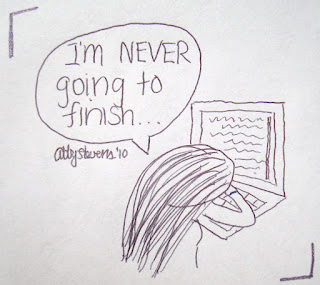
Luckily, both skills can be learned. Some people are innately inclined to one or the other, but either can be mastered through hard work and dedication.
Currently, the beginning and end of my book sit in a bizarre second act-induced purgatory. I have three chapters smack dab in the middle of my book that are suffering from a big ol' plot hole, and how I decide to fix this affects what happens in the end (and maybe even the beginning).
I have no idea how to fix it.
But I'm brainstorming. I'll overcome this obstacle just like I did all the others that got in the way of me being where I currently am with my book.
Until then, I just gotta keep reading, writing and...
[Cue music from PINKY AND THE BRAIN]

...Plotting.
For me, the words come easy. This is my forte. I was that kid in college who could crank out a 12-page research paper in the 12 hours before class and still get an A-. I once wrote a 50-page script the night before the due date and received a 95 on it.
 It is the story that makes me pause. You see, my anti-forte (a new word, perhaps, Mr. Webster?) is storytelling.
Storytelling is what keeps people interested. Very rarely will you hear a person rave about the high quality of writing in a favorite work. What they will rave about is the relatable characters, the immersive world, the detailed mythology, the emotional response.
Storytelling is what compels a person to recommend a book to their friends. It is what makes a reader buy an author's work year after year.
Storytelling is what makes me reread GONE WITH THE WIND and HARRY POTTER again and again when other books are shelved permanently after one read.
Each writer's journey is different. Some struggle to compose clean prose while others bang their heads against the wall as they attempt to craft a tight, engaging plot.

Currently, the beginning and end of my book sit in a bizarre second act-induced purgatory. I have three chapters smack dab in the middle of my book that are suffering from a big ol' plot hole, and how I decide to fix this affects what happens in the end (and maybe even the beginning).
I have no idea how to fix it.
But I'm brainstorming. I'll overcome this obstacle just like I did all the others that got in the way of me being where I currently am with my book.
Until then, I just gotta keep reading, writing and...
[Cue music from PINKY AND THE BRAIN]

NARF!
...Plotting.
Subscribe to:
Posts (Atom)
You might also like...
